Monologues 101
introduction
🤌 what are you talking about?
a guide to all things monologue, from a theatrical perspective:
how to find a monologue
how to analyze a monologue
how to memorize a monologue
💩 why do i give a shit?
monologues are a nice, compact way for you to exercise almost every acting behavioral muscle without relying on the presence of other people. think of it as a playground or a mannequin: put a hat on it, spin it around, go down the slide. have fun with it - it’s yours.

🧰 applications
in theatre, monologues are often used in auditions (or were back in my day)
in film, monologues aren’t really useful beyond making you a stronger actor
in personal life, a monologue is an opportunity to learn the art of not being as boring in conversation/presentation
in in-person WYC acting classes, monologues are a way to apply everything you’ve learned and progress in your understanding
𓋹𓁈𓃠 commandments
Thou shalt not do a monologue from film or tv
it’s hard to make a monologue your own once you’ve seen a great (or just famous) actor do it - you end up just trying to replicate what you’ve already seen
scripts written for movies/tv are different than those written for the stage
i’m a snob, and so are the people you’ll be auditioning for (probably)
Thou shalt only do monologues from full play scripts (short plays are also okay but monologues that are written only as monologues are not)
- a monologue without a play is a skin without a skeleton: you can’t build a character without context
Thou shalt not do popular monologues
see the first point under film/tv monologues
see the third point under film/tv monologues
☥𓅓𓆣 WYC in-person class-specific commandments
if you plan on doing your monologue in WYC classes, these additional rules also apply:
Thou shalt only do contemporary monologues
- i didn’t get to play King Lear at twenty-two so neither do you
choosing a monologue
𖡼𖤣𖥧𓃱𖡼𓋼𖤣𓃮𖥧𓋼𓍊𓃰 where do monologues live?
Warning: if you are doing a monologue for in-person wyc acting classes, contact me via the WYC Discord - I'll show you where to find monologues and approve your monologue before you start working on it.
[easy but lazy]find a monologue compilation book (there are many)[hard but much better]go to a library (or an online resource), grab a stack of plays or play collections (Humana Festival, for example), and flip through
𐦂𖨆𐀪𖠋 what does a good monologue look like?
usually 60–90 seconds long
strong finish that feels intentional, not dropped or overplayed
clear circumstances: who you’re talking to, where you are, what just happened (this one can be workshopped in some cases if the text isn’t clear)
clear perspective
not just thinking out loud
emotional journey or shifts, but within a coherent arc (not just a sequence of random feelings, even if they’re strong or overly dramatic)
𓆝 𓆟 𓆞 i found a monologue but the character is a different age/gender/species - can i still do it?
depends who you ask. generally i say yes - but follow the golden rule:
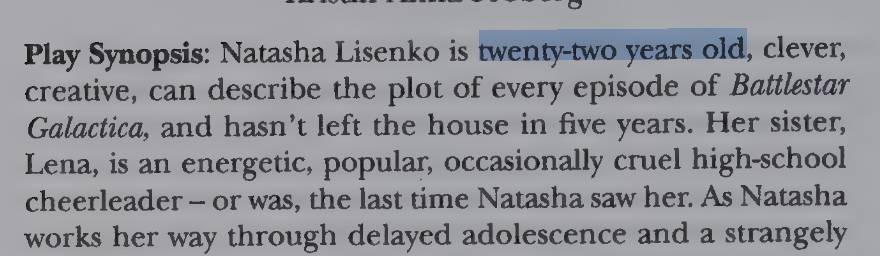
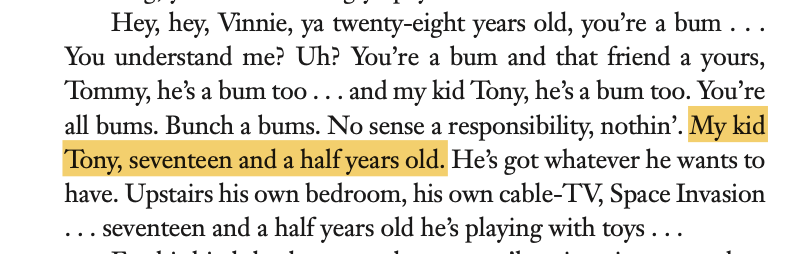
you can ignore traits given to a character outside of the lines (like in the character description) but you can’t ignore traits that are specifically mentioned in the text.
ignore this (you don’t need to be twenty-two years old to do a monologue from this character):
do not ignore this (you cannot play this character if you’re not old enough to have seventeen-year-old son):
analyzing a monologue
▁▂▃▄▅▆▇█ creating levels
a monologue has lots of words in it. not all these words are crucial to the core message of the monologue, although they may be necessary to relay tone or mood. if all words/phrases are delivered with the same weight, the audience will tune out because you’re not making it easy for them to understand the important parts of what you’re saying.
knowing your levels in a monologue doesn’t mean you need to pre-plan volume or pitch changes - it just means you as the performer need to know which words matter most. once you’ve done the homework, the pieces often fall into place by themselves.
in the example below, a level (blue and bold) is crucial information; the information necessary to your character’s argument. b level (red text) is supporting information; evidence to support a claim. c level (unchanged, normal text) is extraneous detail; colorful additions to the language that aren’t essential to the main point.
from Voice: Onstage and Off by Robert Barton and Rocco Dal Vera:
"You, who are normally the most careful driver, a driver widely known for your consideration and even- temperedness, have parked the car, a heavy luxury model, made heavier by my four overfed cousins in the back seat, on top of my foot!"
instructions
divide your monologue into levels by importance, represented by formatting or color.
- you may find more levels in your monologue.
- separate them as you like, but remember not to complicate your work too much.
- both a and b level should read like a shortened monologue, don’t cut out grammatically important words.
example
let’s use the following excerpt from Alone at the Beach by Richard Dresser as an example:
Four years ago my brother, that is, my twin brother, we were in business together. And he got sick and couldn't work all summer and then in the fall he went into the hospital and I visited him every single day after work and he was farther and farther gone until he hardly knew me or my parents and still we thought he would somehow recover.
if you read the entire monologue, he’s telling a story about the slow death of his twin brother, how it felt like watching himself die, and how he recovered from that state of living death over time. if we examine that first paragraph with that in mind, i would suggest that this is the most important (a-level) text (although this exercise is subjective, based on the actor’s assessment of the text):
Four years ago my brother, that is, my twin brother, we were in business together. And he got sick and couldn't work all summer and then in the fall he went into the hospital and I visited him every single day after work and he was farther and farther gone until he hardly knew me or my parents and still we thought he would somehow recover.
notice how the a-level text alone still makes grammatical sense:
Four years ago my brother, he got sick and then in the fall he went into the hospital and still we thought he would somehow recover.
next, we highlight the level b information in red:
Four years ago my brother, that is, my twin brother, we were in business together. And he got sick and couldn't work all summer and then in the fall he went into the hospital and I visited him every single day after work and he was farther and farther gone until he hardly knew me or my parents and still we thought he would somehow recover.
again, the a+b level text reads normally:
Four years ago my brother, that is, my twin brother, he got sick and then in the fall he went into the hospital and I visited him every single day after work and still we thought he would somehow recover.
once you have your levels defined:
create a text version of your monologue text that is only a-level
create a text version of your monologue text that is only a+b level
read through the a-level only monologue multiple times. remind yourself that this is the most important information you have to communicate
once you get the feel for reading a-level only, start reading the a+b level text, but remember that b information is just supporting information to your main point - you don’t have to rush through it, just don’t give it the same importance as a-level
eventually you can add back in all the text of the monologue, trusting your body and behavior to deprioritize words/phrases that aren’t crucial to your point
more examples
i’ve already done this analysis for a few monologues as an example:
𝄞𝄢 alliteration, consonsance, and assonance
alliteration: the occurrence of the same letter or sound at the beginning of adjacent or closely connected words
consonance: the recurrence of similar-sounding consonants in close proximity
assonance: resemblance of sound between syllables of nearby words, arising particularly from the rhyming of two or more stressed vowels
we’re talking about similar sounds here. why? because acting is the process of making consistent, strong choices. text analysis is the process of looking for potential choices that we can make as actors. when a playwright sets down a sequence of similar sounds (intentionally or not), we can use that to create an effect.
shakespeare, for example, makes this extremely easy because shakespeare wrote things like this:
"From forth the fatal loins of these two foes A pair of star-cross'd lovers take their life;"
Romeo and Juliet, Act 1, Prologue
many intelligent-sounding people out there on the internet might claim that the recurring “f”s here signify something - [angry, spitting] or [sad, sighing] but the reality is that the fs mean what the actor wants them to mean. they’re subjective and can be used how you like. here’s another line from that monologue we worked on earlier:
But of course he never did, and he died in early December and watching him like that was like watching my own death
see the repeated consonant?
But of course he never did, and he died in early December and watching him like that was like watching my own death
an actor could really hammer those consonants - maybe in an angry way, maybe with some other interpretation. the point is that noticing these patterns gives the actor an opportunity to make a strong choice. let’s do one more from the same monologue:
I just stayed in bed and after a while I couldn't really tell when I was awake and when I was asleep and what I had dreamed and what had actually happened.
is the character fighting back tears with all those ws? maybe! up to you, dawg.
memorizing a monologue
♕♚♔ slow but effective: isolations
isolations are a way to burn your text into your memory without accidentally tying the words to emotions or punctuation. this allows you to be more free with your interpretation and more flexible with direction. it also ensures you'll "go up" (forget your lines) less often because they exist at an almost subconscious level in your memory.
first, create a version of your monologue text without any punctuation or spacing. you should do it with your entire monologue, but here's just the paragraph we were working with earlier:
four years ago my brother that is my twin brother we were in business together and he got sick and couldn't work all summer and then in the fall he went into the hospital and I visited him every single day after work and he was farther and farther gone until he hardly knew me or my parents and still we thought he would somehow recover
you will read each syllable (not word) of your text at at time, changing either tempo, pitch, or volume slightly with each syllable.
- when performing your tempo isolation:
- do not change pitch or volume
- when performing your pitch isolation
- do not change tempo or volume
- go as high and low as you can, regardless of how silly it sounds
- when performing your volume isolation:
- do not change tempo or pitch
- do not piss off your neighbors
yes, you will sound like an idiot when you do these.
tempo example and yes, i know it sounds stupid
pitch example and yes, i know this sounds even stupider
volume example
i don't use volume isolations personally - yelling at your wall is a good way to get your neighbors to hate you and i live in a society.
✎ᝰ.ˎ fast but lazy: typing
- have your monologue text somewhere nearby
- start writing out your monologue from memory - just the words - as fast as you can (by hand, on a computer, typewriter, doesn't matter)
- check the monologue text at the end of each sentence or so
- when you make ANY mistake in word choice, word order, etc., start from the beginning and write it all again
- repeat this over and over until you can write out your monologue without a mistake
- do this several times a day to keep the text fresh
❚█══█❚ drills with friends
for this exercise you will unfortunately need a friend or otherwise indebited person and a printed copy of your monologue text.
for the person learning the monologue:
- try to recite the monologue out loud from memory
- don't perform the monologue - just speak the text as neutrally and efficiently as possible
- try not to get pissed off at your friend - breathe
for the helper:
- whenever the performer gets ANY word wrong (adds a word, misses a word, skips a word, changes a word), stop them calmly but confidently
- briefly give them the correction - don't waste time with full sentences
- give them a place in the text to start over from, usually one or two sentences before the mistake
- if they make a certain mistake often, reinforce the correct version by making them redo it several times before letting them move on
- once they make it to the end of a chunk or paragraph, make them re-run the entire chunk
- once they seem to have the chunk memorized, allow them to continue on
example
let's use the same monologue from earlier.
monologue text (held by the helper)
Four years ago my brother, that is, my twin brother, we were in business together. And he got sick and couldn't work all summer and then in the fall he went into the hospital and I visited him every single day after work and he was farther and farther gone until he hardly knew me or my parents and still we thought he would somehow recover. But of course he never did, and he died in early December and watching him like that was like watching my own death, we looked exactly alike and talked to each other without words.
performer: Four years ago my twin brother, we were-
helper: "Four years ago my brother, that is, my twin brother". Go back to the beginning.
performer: Four years ago my brother, that is, my twin brother, we were in business together. And he got sick and couldn't work all summer and then he went into the hosp-
helper: "and couldn't work all summer and then in the fall he went into the hospital". Back to "And he got sick".
performer: And he got sick and couldn't work all summer and then in the fall he went into the hospital and I visited him every day-
helper: "every single day". Back to "And he got sick".
performer: And he got sick and couldn't work all summer and then in the fall he went into the hospital and I visited him every single day after work and he was farther and farther gone until he hardly knew me or my parents and still we thought he would somehow recover-
helper: Perfect - one more time, back to the beginning.
performer: Four years ago my brother, that is, my twin brother, we were in business together. And he got sick and couldn't work all summer and then in the fall he went into the hospital and I visited him every single day after work and he was farther and farther gone until he hardly knew me or my parents and still we thought he would somehow recover. But of course he never did, and he died in early December and that was like watching my-
helper: "and watching him like that was like watching my own death". Back to "But of course he never did".
performer: But of course he never did, and he died in early December... I forgot. Line?
helper: "and watching him like that-".
performer: "-and watching him like that was like watching my own death".
helper: Good. Start at "But of course he never did".
performer: But of course he never did, and he died in early December and watching him like that was like watching my own death, we looked exactly alike and talked to each other without words.
helper: Perfect. Back to the beginning, the whole thing.
performer: Four years ago my brother, that is, my twin brother, we were in business together. And he got sick and couldn't work all summer and then in the fall he went into the hospital and I visited him every single day after work and he was farther and farther gone until he hardly knew me or my parents and still we thought he would somehow recover. But of course he never did, and he died in early December and watching him like that was like watching my own death, we looked exactly alike and talked to each other without words.
more guidance for WYC students
if you're interested in doing your monologue for in-person WYC classes, let me know via discord and i'll share the community resources with you to make this process easier.